The Neighbor
A Williamsburg Love Story in Six Acts

In a three-story walk-up on Havemeyer Street, two neighbors orbit each other through the quiet chaos of early-2000s Williamsburg, Brooklyn — a world of cheap coffee, thrift-store flannel, and half-finished art. The Neighbor follows Iris, a small-press publicist with too many feelings and not enough filters, and Jude, a brooding photographer trying to rebuild his life one frame at a time.
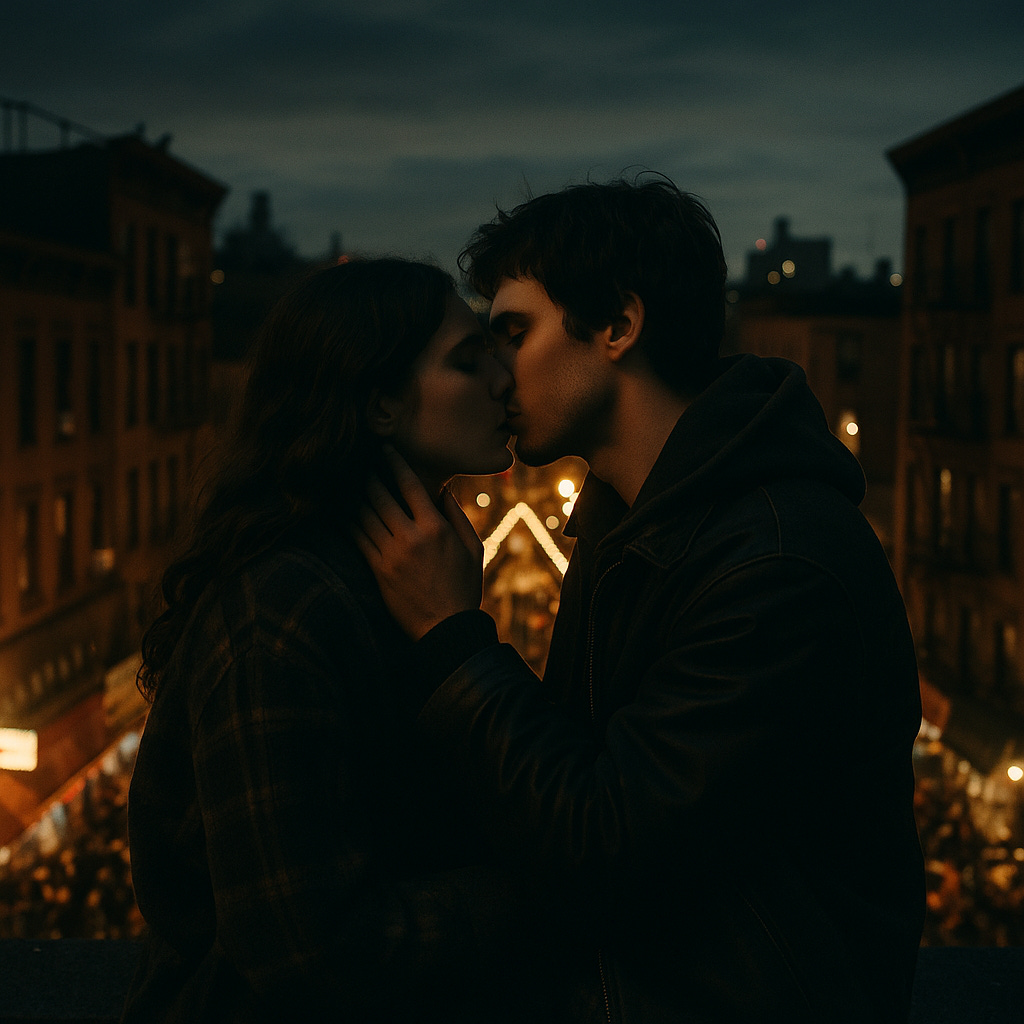
Over six acts, their friendship stretches and swells with the pulse of the city around them. From tea shared in dark apartments to rooftop kisses above the San Gennaro Festival, it’s a slow burn of wanting and restraint — two people learning that sometimes love doesn’t arrive all at once, but in flickers, through walls, and across the hall, in small moments gathered and shared.
Act 1: He was the neighbor.
It started with excuses.
Dropping by his apartment under the pretense of returning a borrowed book or asking about a photo he’d mentioned.
He always said yes. Always let me in.
Our building sat on Havemeyer Street, the kind of three-story walk-up where the walls hummed with someone’s bass and the heat only worked when it felt like it. You could smell the bagel shop downstairs in the mornings and hear the bar two doors down at night.
Jude had this quiet gravity — the kind that made you lean closer just to hear him breathe. He didn’t talk much, but when he did, it was like being seen in high-definition. Everyone else felt blurry after that.
He’d be sorting prints on his kitchen table, the smell of developer sharp in the air, sleeves rolled to his elbows. His wrists were all tendon and shadow. Out the window, you could hear the B62 wheeze by and someone arguing about rent.
I started to learn the rhythms of his life without meaning to — when the kettle whistled, when the building door slammed, when his music changed moods.
I told myself it was just interest. I was a publicist, after all. I was supposed to pay attention.
But then I started timing my laundry runs for when I’d hear him coming up the stairs. I’d pause in the hallway when I caught his door open, pretending to fumble for my keys.
Sometimes he’d invite me in for coffee, sometimes not. It didn’t matter. The wanting was its own company.
At night, I’d read his favorite poets — Bukowski, Carver, Rilke — and imagine how he’d underline the same lines I did. I started writing again, just little fragments:
“I live across the hall from a storm pretending to be calm.”
I’d write them in my notebook, then close it fast, like I’d caught myself doing something indecent.
The worst part was how ordinary it all looked from the outside. Two neighbors, two friends.
But I’d begun to measure time in his door creaks, his footsteps, the clink of his camera strap against the hallway rail. Moments that hung in the air.
And every time he smiled at me — that small, crooked thing that seemed to mean nothing — I felt it like a match held too close to paper.
Act 2: Was it the snowlight?
It was one of those Brooklyn mornings that looked gray until you stepped outside — then the sky opened up in white confetti. Big, lazy flakes that didn’t seem in any hurry to fall.
I’d just turned the corner onto Bedford when I heard him call my name.
Jude. Hood up, fake leather jacket zipped to the throat, camera bag slung across him like an extra limb. He looked like every NYU art student I’d ever rolled my eyes at — except he wasn’t pretending.
“Hey,” he said, his breath turning to fog. “You’re out early.”
“Manuscript delivery,” I said, holding up the tote bag digging into my shoulder. “And you?”
“Needed light,” he said simply, as if that explained everything.
The wind whipped between the buildings, carrying the smell of burnt espresso from the Bedford Café. We ducked inside — the one with the thrift-store couches and the record player that never spun quite evenly. The bell over the door gave a tired jingle.
Inside smelled like coffee grounds and wet wool. My hair was damp at the ends, his coat glittered with melting flakes. We found a corner table near the window, the radiator hissing beside us like an old friend.
He ordered an Earl Grey, his normal, with milk and honey, I got the same without even thinking. We sat close — closer than friends sit, but not close enough for anyone to notice. The kind of closeness that hums in the air like an unfinished song.
He leaned forward, elbows on the table, fingers wrapped around his cup. “You’ve got snow on your eyelashes,” he said.
I laughed, brushing at my face. “That’s poetic.”
He smiled, eyes soft. “It’s distracting.”
The tea sent its warmth up between us, ribbons of bergamot and steam. His knee brushed mine under the table — once, then again — maybe by accident, maybe not. Neither of us moved. The moments hung in time like dust caught in a shaft of light—suspended, weightless, shimmering just long enough to make you believe they’d stay that way forever.
Outside, Bedford Avenue blurred into white noise — cars ghosting by, someone shouting over the hiss of the bus. Inside, it felt like the center of something we hadn’t named yet — a stillness that made the heart work harder just to fill it.
I remember thinking that if I leaned in even a fraction, the air would break like glass.
Act 3: He became my almost everything.
By spring, it was a rhythm.
Jude and me — the hallway check-ins that turned into whole days. The coffee runs, the warehouse pop-ups, the nights when one of us would knock just to say, you up? and it wasn’t about anything but not being alone.
He started calling me “kid,” even though I was two years older.
I started calling him “old man,” even though he wasn’t.
We had our spots — Bedford Café in the mornings, Rough Trade for Galaxie 500 record hunting, the pier off Kent where you could see the skyline shimmer like it was remembering itself.
He’d bring his camera, I’d bring my notebook. We pretended we were working, but really, we were just orbiting.
He’d tell me about shots that didn’t turn out, about a professor who thought his work was “too sentimental for a realist.” I’d tell him about my authors, my impossible deadlines, the zines that died in boxes before anyone read them. We made each other laugh — real, belly laughs — the kind that break you open.
People at the laundromat started assuming we were together. The barista at Bedford gave us the couple’s discount without asking. We didn’t correct them, just exchanged a glance like, if only they knew.
Sometimes, I’d catch him looking at me when he thought I wasn’t watching — eyes unfocused, like he was framing me through a lens. Other times, he’d brush a crumb from my cheek, or fix my scarf, or squeeze my shoulder without thinking. Those moments undid me.
I told myself it was friendship, told myself I was safe here — that as long as we didn’t name it, it couldn’t fall apart.
But I started dreaming in black-and-white.
Started catching myself writing his name in margins, on receipts, in places I’d have to cross it out before he saw.
We were always almost something. Always almost at our shared moment.
Always on the edge of saying too much.
And maybe that was the point — to stay in that charged middle space, where nothing was broken yet.
Act 4: The night it almost happened.
The city was glittering like it had dressed up for him.
Jude’s show had opened in a reclaimed warehouse gallery on Orchard Street — white walls, bad wine, beautiful people pretending not to stare. His photos hung like confessions: strangers’ faces caught mid-thought, lit by the kind of truth that made you look twice.
He’d been quiet all night, accepting congratulations like they were too heavy to hold. I stayed close — smiled when he forgot to, refilled his cup, whispered small things to keep him anchored.
When we finally stepped outside, the air was sharp and electric, that early-summer kind of cool that makes you aware of your skin. Orchard hummed around us — taxis swerving, music leaking from a dive bar, steam rising from a manhole like the city was sighing.
He looked at me then — really looked — the way he looked at the people in his photos. The way that made you feel like you were both the subject and the light.
“Thank you,” he said softly.
“For what?”
“For being here. For… all of it.”
I shrugged, smiling. “Where else would I be?”
He laughed, the kind of laugh that carried something unsteady. Then he reached for me — slow, like he wasn’t sure he had the right. His arms wrapped around me, warm and solid. I sank into him, meaning to make it brief, just a congratulations hug, but neither of us moved.
We just stood there, pressed close, his chin grazing my hair, the city roaring quietly around us. When I finally pulled back, his cheek brushed mine — accidental, maybe. But it felt like electric static, like the moment before lightning.
He looked down at me, eyes searching, and for a heartbeat I thought he’d kiss me. I thought this is it. This is our moment.
But then someone called his name — a friend, a voice from the gallery — and the moment scattered like the first drop of rain. Another moment gone.
We stepped apart. Smiled like we hadn’t just crossed an invisible line.
“Come on,” he said. “Let’s walk.”
So we did — down Orchard to Delancey, over the bridge, back to Williamsburg. The skyline behind us, the hum of the bridge beneath our feet. By the time we reached Havemeyer, it was almost dawn. We said nothing. We didn’t need to.
Act 5: When he first stayed.
It was just supposed to be tea.
The hallway lights in our Havemeyer Street building flickered as he knocked, soft, two quick taps that were already part of our rhythm. I opened the door, half expecting him. He was still in his gallery clothes — black jeans, hoodie, the fake leather jacket that always carried the smell of rain and cigarettes.
“Couldn’t sleep,” he said, rubbing the back of his neck. “You got any tea?”
I nodded, stepping aside. “Always.”
He kicked his boots off at the door, like he lived there. I filled the kettle, the faint sound of the L train in the distance threading through the open window. He leaned against the counter, watching me in that way he did — quiet, steady, like the act of boiling water was worth his full attention.
We sat cross-legged on my bed, mugs warming our hands.
Outside, the wind brushed the fire escape, rattling the loose ladder like a restless thought.
He told me the opening had gone better than expected, that someone wanted to feature his work in a small journal. I told him I was proud. I meant it, too — it rose in my chest like warmth from the tea.
When the conversation faded, the silence didn’t feel empty. It felt full. His leg brushed mine once, then didn’t move. My fingers toyed with the mug handle, buying time I didn’t know what to do with.
Eventually, he set his tea down and lay back, folding one arm under his head. “I’m too wired to sleep but too tired to be awake.”
“Stay,” I said before I could stop myself.
He looked at me — searching, soft. Then nodded.
I slid down beside him, both of us still on top of the blanket. The air felt delicate, like if we spoke too loud the spell would shatter.
At some point, I must’ve drifted off, we both did into a mid-morning nap. When I woke, it was still light out, the sun spilling through the blinds. Our limbs were tangled, facing the same direction. Spooning. His arm was wrapped around me, his breath against my neck — steady, human, terrifying in its rightness.
I didn’t move. I wasn’t sure if he was as awake as I was. But he didn’t move either. It’s as if we were suspended together in this quiet moment.
Every small shift — a sigh, a stretch, a brush of his thumb — felt monumental. The world outside could’ve frozen and I wouldn’t have noticed.
By late afternoon, the city was gray again and beginning its afternoon hum. We had napped on and off all afternoon, tousled into each other.
When he sat up, he ran his fingers through his tousled hair saying, “Tea’s cold.”
I smiled, pretending to stretch. “Guess we’ll have to make more.”
He grinned, that quiet half-smile that meant nothing and everything.
Then he slipped back across the hall, leaving the scent of Earl Grey and the city waking up below us — the hiss of espresso machines, the clang of the garbage truck, and the slow, inevitable hum of another Brooklyn morning where nothing had changed and somehow everything had shifted.
Act 6: The day of the feast.
It was the night of the Feast of San Gennaro — or at least the Williamsburgy version of it, spilling over from the old Italian blocks and snaking its way down Metropolitan. The kind of night that made the whole neighborhood hum: neon lights, sausage smoke in the air, laughter rising up from the street like static.
From our roof on Havemeyer, we could see everything — the parade inching along below, people craning from fire escapes to watch the three-story statue sway past. A brass band played something both joyful and mournful, the kind of tune that sounds like memory.
Jude had dragged two folding chairs up there earlier, and a blanket that smelled faintly of his apartment — darkroom chemicals and cedar soap. The sky above Williamsburg glowed a soft orange, the bridge lights flickering like pulse beats.
I’d brought a bottle of cheap prosecco from the bodega, the kind that hisses instead of pops. We passed it back and forth, watching the statue of the saint rock down the block, gold robes shimmering under streetlight.
“Feels like a dream,” I said.
“It’s Williamsburg,” he answered. “It’s always a little unreal.”
Below us, confetti caught the wind and lifted high enough to reach the roofline. One piece landed in his hair, a tiny red square against the dark. Without thinking, I reached up and brushed it away.
He didn’t move.
For a second, neither of us breathed. The music below swelled, a trumpet catching the night and bending it into light.
“You ever think,” I said, voice barely above the wind, “that maybe we’ve been waiting for the wrong moment?”
He looked at me then, that same steady gaze he used on film — patient, intent, like he was composing something sacred.
“Maybe,” he said. “Or maybe this is it.”
He leaned in slowly, so slow I could feel the air shift between us — the faint scent of bergamot from his tea, the warmth of the city rising through the tar roof. When his lips finally found mine, the band below hit a high note, the kind that makes you believe in something you can’t name.
It wasn’t rushed or hungry. It was the kind of kiss that had been waiting — years distilled into a single heartbeat, silence blooming into sound.
When we finally broke apart, the crowd below erupted for the saint, but it felt like the applause was for us — for finding our way at last.
We stayed close, foreheads resting together, the fireworks from the river threading gold through his lashes.
Somewhere down on Bedford, someone was shouting about cannoli and saints; the L train wailed like an echo of the night.
And above it all — the noise, the light, the endless city hum — we stayed suspended in that small, infinite pause where two lives, after all the circling, finally land on the same moment.